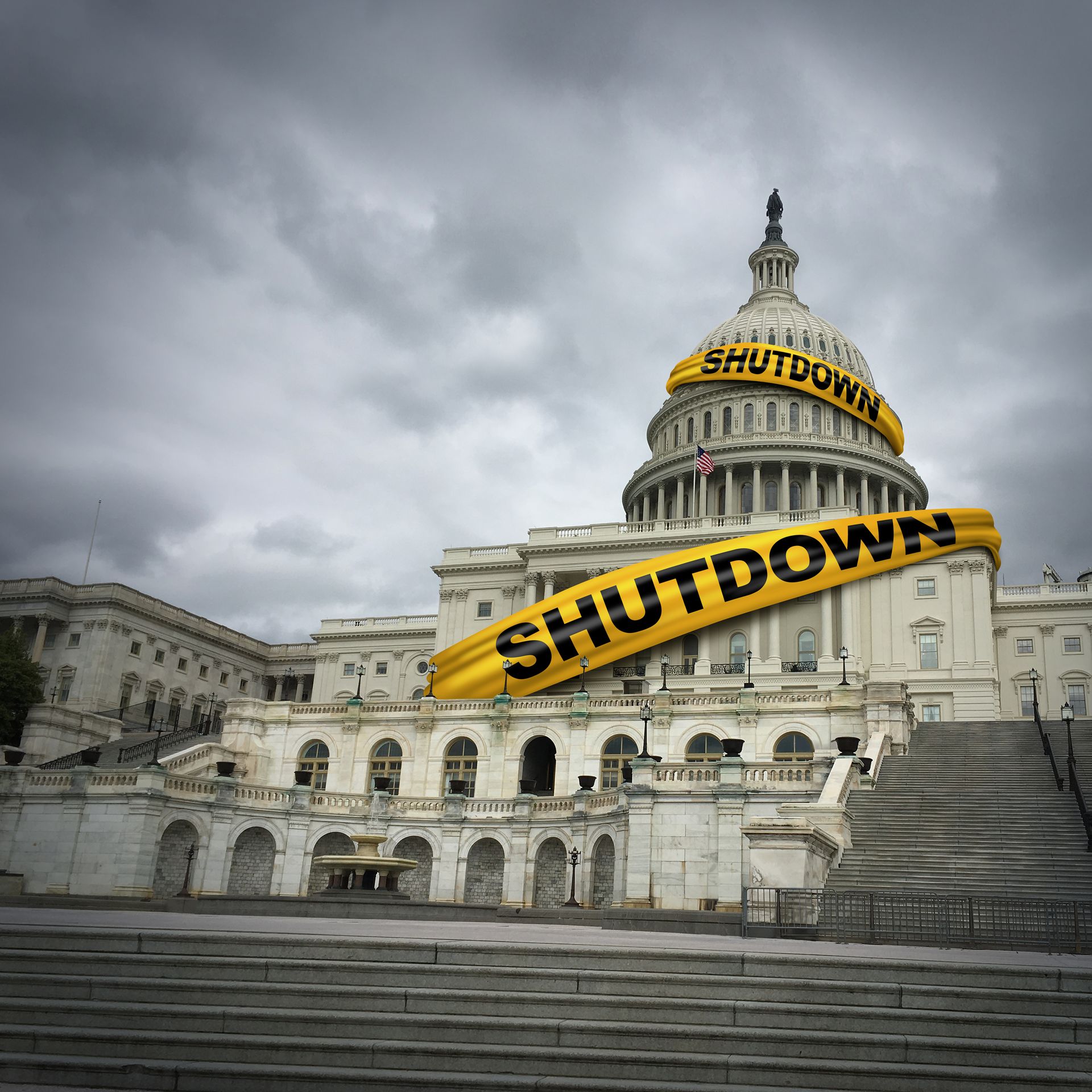

The US government has shut down from today as politicians failed to agree on a plan to continue funding it. This is not the first time this has happened, and it certainly won’t be the last. Since 1976, there have been around 20 government shutdowns, caused by funding gaps lasting at least one business day. The average duration is about 8 days. Most shutdowns last only a few days, and only a handful stretched over multiple weeks. The longest in recent history was a partial shutdown that lasted 35 days between December 2018 and January 2019.
The market impact of shutdowns is not necessarily dramatic — far from it.
For bonds, the flight to safety usually benefits US Treasuries, and since the government continues servicing its debt during shutdowns, the overall impact is limited, slightly positive. That’s what we see this morning, with the US 10-year yield edging lower on shutdown headlines.
On the currency front, the US dollar tends to weaken when the government shuts down. Limited dollar appetite and a softer DXY come as no surprise today. The yen and Swiss franc are attracting safe-haven flows, the EURUSD looks set to test the 1.18 area and could clear resistance if the shutdown drags on, while Cable could push back above 1.35 despite ongoing UK political noise.
For equities, the impact of a government shutdown could be positive. In fact, the S&P500 gained during three of the last four government shutdowns, and it gained more than 10% during the 2018-2019 shutdown that also coincided with a Federal Reserve pivot.
Shutdown news is weighing on US futures this morning, but they’re not the end of the world. The most inconvenient impact will be delays to economic data — and this week, that includes the all-important jobs report.
Speaking of data: yesterday’s JOLTS figures came in stronger than expected, with last month’s number revised slightly higher. That said, job openings are now at their lowest since 2021 and weaker-than-expected consumer confidence and a sharper contraction in Chicago PMI released yesterday also supported the dovish Fed outlook. The US 2-year yield has fallen for a fourth straight session.
Today, ADP — a private data provider unaffected by the shutdown — will publish its September jobs report. It is expected to show a soft gain of around 50K jobs. Even if Friday’s official payrolls are delayed, JOLTS plus ADP could still give investors a decent picture of labour market momentum and keep Fed expectations intact. A weaker ADP reading would reinforce the dovish view, pushing US yields and the dollar lower while supporting equities. A stronger print could temper those expectations, but only a very robust figure in the 150–200K range would seriously challenge the market’s assumption of upcoming cuts — and that seems unlikely given recent labour trends. As such, the more probable scenario is continued softness in US jobs data, keeping downward pressure on the dollar.
The weaker dollar has already been a boon for precious metals. Gold and silver remain heavily in demand, with both seen as overbought but still attracting inflows. Add in the US-China trade tensions, broader geopolitical risks, waning appetite for USD and Treasuries, and now the shutdown, and the bullish case for gold remains strong. Historical patterns and technical signals also back that view.